

What Is Collagen Supplement ODM?
Collagen supplement ODM, or Original Design Manufacturing, refers to a manufacturing arrangement in which a specialized supplier participates in product design, formulation development, ingredient selection, production, and sometimes packaging development for another company's brand.
Rather than developing every aspect of a collagen supplement independently, brand owners can collaborate with an ODM manufacturer to create products that match their target customers, positioning, distribution channels, and commercial objectives.
Collagen supplement ODM services can support startups, established supplement companies, beauty and wellness brands, distributors, and businesses seeking to expand their private-label product portfolios.
Collagen Supplement ODM vs. OEM: What Is the Difference?
ODM and OEM manufacturing are closely related, but they differ in the manufacturer's level of involvement in product development. Under an OEM arrangement, the brand commonly supplies an established formulation or detailed product specifications for manufacturing. Under an ODM arrangement, the manufacturing partner may develop or adapt the formulation, recommend ingredients, and support broader product development.
| Comparison | ODM | OEM |
|---|---|---|
| Product Development | Manufacturer may develop the formula | Brand commonly provides specifications |
| Ingredient Selection | Collaborative development | Primarily brand-directed |
| Formulation Flexibility | Depends on development agreement | Based on supplied specifications |
| Suitable Customers | Brands needing formulation support | Brands with established formulations |
The distinction is not always absolute. Some manufacturers combine ODM, OEM, and private-label services, so brands should confirm exactly which development responsibilities are included in their contracts.
Types of Collagen Supplements Available for ODM
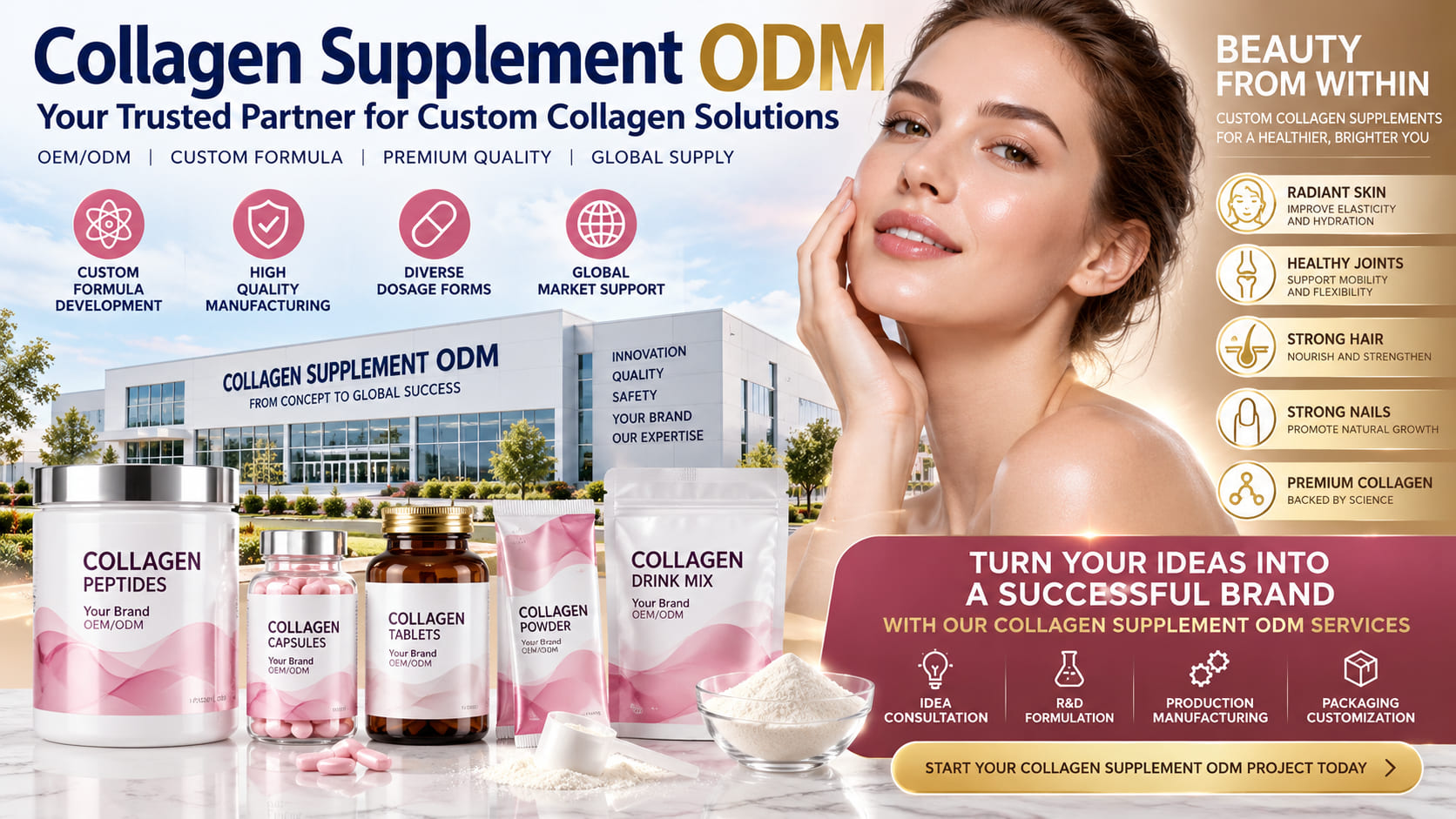
Collagen supplement ODM manufacturers may offer multiple dosage forms and packaging formats. The appropriate product type depends on the desired serving size, ingredient compatibility, target audience, consumer convenience, and manufacturing capabilities.
1. Collagen Powder Supplements
Collagen powders are a common option for brands seeking flexible serving sizes. They may be supplied in tubs, refill pouches, or individually packaged sachets. Formulation development should consider dispersibility, taste, odor, moisture sensitivity, ingredient compatibility, and the intended serving quantity.
2. Collagen Capsules and Tablets
Capsules and tablets are convenient for consumers who prefer measured portions without mixing powders or liquids. However, the amount of collagen that fits into each unit is limited by the dosage form, so brands need to evaluate whether the desired serving size is practical.
3. Collagen Stick Packs and Sachets
Single-serving stick packs can support portability, portion control, and subscription-based product concepts. ODM manufacturers must evaluate filling accuracy, packaging barrier performance, powder flow, and seal integrity for the proposed formulation.
4. Liquid Collagen and Functional Beverages
Liquid collagen products may be developed as ready-to-drink beverages, concentrated shots, or other permitted formats. Compared with dry products, liquids may require additional attention to microbiological stability, preservation systems, processing compatibility, packaging, and shelf-life validation.
Collagen Supplement Formulation and Ingredient Selection
Custom formulation is one of the central advantages of collagen supplement ODM. However, successful product development involves more than selecting an attractive ingredient combination. Manufacturers must consider raw-material quality, dosage feasibility, flavor, stability, processing requirements, allergen management, and applicable regulations.
Marine Collagen
Marine collagen is generally sourced from fish or other marine-derived materials, depending on the supplier's specifications. Marine collagen peptides are commonly used in beauty-oriented supplement concepts. Brands should confirm species, sourcing information, allergen declarations, peptide specifications, and relevant quality-testing documentation.
Bovine Collagen
Bovine collagen ingredients are generally derived from cattle sources. They may be considered for a variety of collagen supplement formulations. Supply-chain documentation, manufacturing specifications, source materials, and market-specific import requirements should be reviewed before selection.
Hydrolyzed Collagen Peptides
Hydrolyzed collagen is processed into smaller peptide fragments. Manufacturers may evaluate molecular-weight distribution, solubility, sensory characteristics, and compatibility with other formulation ingredients. A lower molecular weight alone does not establish superior clinical effectiveness, and product claims should be supported by appropriate evidence.
Additional Functional Ingredients
Depending on the product concept and destination market, collagen formulations may include vitamin C, hyaluronic acid, selected vitamins, minerals, flavor systems, or other permitted ingredients. Each additional component should be evaluated for safety, dosage, labeling requirements, stability, and evidence supporting any proposed benefit claims.
Important Formulation Consideration: Collagen ingredients vary by source, composition, processing method, and intended use. Formulation decisions should be based on documented specifications and the requirements of the target market. Product development should not assume that a collagen supplement can prevent, treat, or cure medical conditions.
Collagen Supplement ODM Process: Five Steps
A structured manufacturing process helps brands identify technical limitations, commercial requirements, and potential compliance issues before large-scale production begins.
Step 1: Product Concept and Requirements
The brand defines its target customers, intended sales market, preferred collagen source, dosage format, product positioning, packaging preferences, and expected retail price. The ODM manufacturer evaluates whether the proposed concept is technically and commercially feasible.
Step 2: Ingredient Selection and Formulation Development
The manufacturer selects potential ingredients, develops preliminary formulation specifications, evaluates compatibility, and prepares prototypes where appropriate. This stage may involve multiple adjustments to serving size, flavor, texture, appearance, and packaging compatibility.
Step 3: Sample Evaluation and Testing
Samples are evaluated against agreed product requirements. Depending on the formulation, testing may address identity, composition, microbial quality, contaminants, sensory properties, physical stability, and other specifications. Necessary stability studies and validation activities should be identified before commercialization.
Step 4: Packaging Approval and Manufacturing
Once the formulation, packaging specifications, labeling, and commercial terms are approved, the manufacturer schedules procurement and production. Manufacturing controls should address raw-material acceptance, weighing, mixing or other relevant processing, filling, packaging, traceability, and documented quality procedures.
Step 5: Quality Release and Delivery
Completed batches undergo the applicable release process before shipment. Brands should confirm required test reports, batch documentation, packaging quantities, shipping arrangements, and any market-specific documentation. Production completion does not automatically mean regulatory authorization to sell the product in every country.
How to Choose a Collagen Supplement ODM Manufacturer: Six Key Factors
Selecting a collagen supplement ODM manufacturer requires reviewing technical capabilities, quality-management practices, commercial transparency, and the manufacturer's ability to meet the requirements of your target market. The following six factors can help reduce supplier-selection risks.
- Verify Manufacturing and Quality Certifications: Ask which manufacturing standards apply to the proposed product and facility. Request current certification documents, scope details, and quality-system information rather than relying on promotional statements.
- Check Collagen Ingredient Traceability: Confirm ingredient origin, supplier specifications, relevant allergen information, and available certificates of analysis. Different collagen sources may have different regulatory and labeling implications.
- Evaluate Formulation and Development Capabilities: Determine whether the manufacturer can create original formulas, modify existing products, conduct prototype evaluation, and address stability or production challenges.
- Clarify Minimum Order Quantities: MOQ requirements may vary by formulation, product format, packaging material, and production-line configuration. Ask about trial orders, initial commercial quantities, and repeat-order conditions.
- Review Regulatory and Labeling Support: Confirm whether the supplier provides ingredient documentation, labeling information, and market-specific regulatory support. The brand should still obtain an appropriate regulatory review for the destination market.
- Compare Transparent Quotations and Contracts: Request a breakdown covering formulation development, testing, production, packaging, freight, tooling, and any additional charges. Clarify formulation ownership, confidentiality, change controls, and responsibility for rejected batches.
Collagen Supplement ODM Costs and Pricing Factors
Collagen supplement ODM pricing varies according to raw-material specifications, formulation complexity, production quantity, packaging format, testing requirements, and the level of development support. There is no universal per-unit manufacturing price that applies to every collagen product.
| Cost Factor | Impact on Manufacturing Cost | What to Confirm |
|---|---|---|
| Collagen Source | Different source materials and specifications have different procurement costs. | Origin, quality specifications, documentation |
| Collagen Content | The amount per serving influences ingredient consumption and dosage feasibility. | Serving size and formulation requirements |
| Additional Ingredients | Functional ingredients, flavors, and other components may increase costs. | Complete ingredient list and quantities |
| Dosage Form | Powders, capsules, tablets, and liquids require different equipment and processes. | Manufacturing format and capacity |
| Packaging | Custom printed materials, filling formats, and package complexity affect costs. | Packaging specifications and minimum quantities |
| Testing and Validation | Additional analytical testing and stability work may be necessary. | Test scope, documentation, acceptance criteria |
| Order Quantity | Production volume affects setup-cost allocation and potential economies of scale. | MOQ, batch sizes, repeat-order conditions |
How Can Brands Control Collagen ODM Development Costs?
Brands can improve cost visibility by preparing a detailed product brief before requesting quotations. The brief should establish mandatory ingredients, desired serving size, acceptable packaging alternatives, initial order quantities, and target markets.
A manufacturer may be able to suggest alternative packaging materials, available formulation platforms, or practical production quantities. However, cost reductions should not compromise required quality controls, product safety, label accuracy, or regulatory compliance.
Choosing an ODM Strategy for Different Markets
Collagen supplement ODM projects may target domestic sales, international distribution, online marketplaces, professional wellness channels, or beauty-focused retail networks. Each market has its own requirements for ingredient eligibility, product classification, documentation, labeling, and advertising.
United States Market
For products marketed as dietary supplements in the United States, applicable FDA dietary supplement requirements and manufacturing rules must be considered. Requirements may include current good manufacturing practices, appropriate labeling, ingredient review, and substantiation of product claims. Whether a product qualifies as a dietary supplement depends on its characteristics and intended use.
European Union Market
Products intended for EU markets require review under applicable food-supplement, ingredient, labeling, and nutrition and health-claims rules. Brands should also evaluate whether specific ingredients are subject to novel-food requirements and whether additional national notification obligations apply.
Asian and Other International Markets
Regulatory classifications and ingredient restrictions vary across Asian countries and other international markets. Product labels, permitted claims, importer obligations, and documentation should be reviewed for each destination. A formulation accepted in one jurisdiction should not automatically be assumed compliant elsewhere.
What to Prepare Before Requesting an ODM Quotation
A clear product brief helps collagen supplement ODM manufacturers provide more relevant technical recommendations and commercial proposals. Before contacting a manufacturer, brands should prepare the following information.
- Target customers and intended product positioning
- Destination country or sales markets
- Preferred collagen source and ingredient specifications
- Desired dosage form and serving size
- Additional ingredients and flavor preferences
- Packaging type and estimated unit quantity
- Expected minimum order quantity and budget
- Required testing and certification documentation
- Target launch date and delivery expectations
- Artwork, labeling, and customization requirements
Request a Collagen Supplement ODM Consultation
Planning to launch a customized collagen supplement? Prepare your intended formulation, target market, packaging requirements, and estimated order volume before requesting a manufacturing quotation.
Contact a qualified collagen supplement ODM manufacturer through its official inquiry form, business email, or sales consultation channel to discuss development feasibility, minimum order quantities, sample arrangements, manufacturing capabilities, and quotation details.
Collagen Supplement ODM Frequently Asked Questions
Q1: What services are included in collagen supplement ODM?
Collagen supplement ODM may include product concept development, ingredient sourcing, custom formulation, sample development, manufacturing, packaging, quality testing, and technical documentation. The exact service scope depends on the manufacturer and commercial agreement.
Q2: Can a collagen supplement ODM manufacturer support international customers?
Some ODM manufacturers support international brands and export projects. Brands should confirm production location, shipping capabilities, required documentation, importer responsibilities, and regulatory requirements for each destination market.
Q3: How do I start a collagen supplement ODM project?
Start by preparing a product brief covering the target market, collagen source, dosage form, serving size, packaging preferences, estimated order quantity, and budget. The manufacturer can then assess feasibility and provide development recommendations.
Q4: How long does collagen supplement ODM development take?
Development time depends on formulation complexity, sample revisions, ingredient availability, packaging procurement, testing, and regulatory requirements. Manufacturers should provide a project-specific schedule rather than a universal completion guarantee.
Q5: What is the minimum order quantity for collagen supplement ODM?
Minimum order quantities vary by manufacturer, dosage form, ingredient requirements, and packaging format. Custom printed packaging and specialized formulations may have different MOQ requirements from standard production options.
Q6: Can I develop a custom marine collagen supplement?
Custom marine collagen formulations may be available depending on the manufacturer's sourcing and production capabilities. Ingredient origin, fish allergen declarations where applicable, quality specifications, and target-market requirements should be reviewed before development.
Q7: Can ODM manufacturers develop collagen powders, capsules, and drinks?
Manufacturers may support collagen powders, capsules, tablets, sachets, stick packs, and liquid products. Available formats depend on their equipment, formulation expertise, packaging capabilities, and applicable product regulations.
Q8: What affects collagen supplement ODM manufacturing costs?
Manufacturing costs depend on collagen source, ingredient quantities, formulation complexity, dosage form, packaging, testing requirements, order volume, and development services. Request an itemized quotation based on the proposed specifications.
Q9: Can collagen supplement ODM manufacturers provide custom packaging?
Many ODM manufacturers offer packaging customization, subject to their available production lines and supplier arrangements. Brands should confirm packaging materials, artwork requirements, labeling review, print quantities, and packaging-related costs.
Q10: How can I choose a reliable collagen supplement ODM manufacturer?
Evaluate manufacturing standards, ingredient traceability, quality-testing capabilities, formulation expertise, regulatory support, communication, minimum order quantities, and contract transparency. Request supporting documentation and compare manufacturers against the requirements of your specific project.